Showing posts with label alaska. Show all posts

Tuesday, August 13, 2013

A HURRICANE TURN AND BEARS IN THE WOODS…

Heading north we cruise past Anchorage and enter Alaska’s heartland, the Mat-Su Valley.  Since there are no RV parks in Anchorage with a decent reviewer rating we choose to stay about forty-five minutes away in Palmer at the Mountain View RV Park.  Although the name of this park is hardly original, the mountain views here are pretty spectacular. The spaces are tight and the park is crowded since this is a popular stopping point for caravans.  We can only get a power and water site, but since these spaces are not full, we have a bit more room and the Wi-Fi is OK (after all of the caravan folks go to bed, and since they’re mostly old, they don’t stay up too late.)

Native Dancer
It may be a sacrilege to say this out loud, but Anchorage just has no appeal for us.  Just another urban center with malls and restaurants, albeit in a lovely location, but most of Alaska is lovely.  It just doesn’t float our boat.  There is one attraction of interest for us: The Alaska Native Heritage Center.  The theme here is “Changing Lives, Living Values” a place to explore the traditional and contemporary ways of Alaska’s indigenous societies and the success of these people as they continually adapt to an ever-changing world.  We start with a guided tour of traditional native dwellings of the five distinct cultures.  Here we learn a bit about customs and daily life of the early residents. The hunting, gathering and storing of food during the long days of summer and the efficiency of the shelters to protect the people from the harsh winters and the predatory polar bear. After the tour we enjoy a demonstration of the music and dance of the different groups. It is interesting that the dancers express themselves through hand and body movement while staying in place. The time for dancing, music and story telling is winter and the dwellings do not allow a lot of room for large body movement. There is also a demonstration of traditional games.  The emphasis is on strength and agility.  It’s mind boggling to see these young athletes kick a ball suspended high in the air over their heads with a short lunge forward and land on their kicking foot. In the Hall of Cultures there are interactive displays highlighting the arts, crafts and tools of the five groups.  Here we also meet native artists and see their contemporary expression of traditional arts.

Next, we head north on the Parks Highway through Wasilla (a suburban land of strip malls) and land in Trapper Creek at the Trapper Creek Inn and RV Park.  It’s a small park with an inn, gas station, café, public laundry and mini-mart.  Spaces are narrow but there are a lot of trees and it’s pretty quiet even though it’s right on the Parks Highway.  Wi-Fi here is excellent! 

The nearby town of Talkeetna is unique in many ways. A popular rumor is that fifteen years ago the town elected their mayor, Mr. Stubbs as a write in candidate and the town has loved him ever since. We actually saw Mr. Stubbs strolling down Main Street and into Nagley’s Store where the Mayor’s office is located.  What set’s Mr. Stubbs apart from other politicians is not his leadership qualities but his background.  Mr. Stubbs is a part Manx ginger feline! So what’s not to like about a town with a cat for a mayor?  In addition to it’s kitty politics: Talkeetna is the jump off spot for mountaineers climbing Mt. Whitney (AKA Denali.) There are a number of air-taxi services to take climbers to the base camps. The Alaska Railway has a depot in Talkeetna and the town entertains hundreds of tourists daily.  There are restaurants a plenty, charming hotels, art galleries and gift shops.  It is also located at the confluence of three rivers, the Susitna, Chulitna and Talkeetna so there are lots of water sports and of course fresh water fishing. Stopping at the visitor center we inquire about the best not to miss attractions in the area.  We decide on boats and trains and pass on the planes

We visit the Talkeetna Historical Society Museum. It is a collection of vintage structures including the Ole Dahl Cabin #1 that is probably the oldest existing building in the town.  The museum houses a typical collection of late nineteenth and early twentieth century memorabilia: trapping, mining, railroads, bush pilots and a few native artifacts. But it’s worth a stop to see the Mountaineering exhibit with the twelve foot square scale model of Mt. McKinley.

The Twister Creek Restaurant and Denali Brewing Company offer five-ounce samples of eleven brews for $2 to $3 each.  We pick five with alcohol contents ranging from 5.1 to 9.6 percent and a smoked salmon dip with capers, chopped red onions, cucumbers and a sliced fresh baguette. We enjoy these alfresco while people watching and soaking up the Alaska summer sunshine.
Twister Creek Resturant and Denali Brewing Company on Urbanspoon

Collecting Birch Sap
We stop at the Kahiltna Birch Works and sample some Birch Syrup, and candies.  We also take a tour of the processing plant. Birch Syrup is interesting, similar to molasses but with some slight herbal notes. It would be a good ingredient for sauces, glazes and baking.  We considered purchasing a small bottle, but a large group showed up as we finished our tour and the lone employee was tied up giving them a tour. The syrup was good, but not worth hanging out for fifteen minutes...  If we decide we really need it later…they do have mail order.

Now all bakeries smell good, but the scents in the FlyingSquirrel Bakery and Café are beyond amazing! This place is so good; we HAVE to make multiple stops during our time here.  Their Rugulas are to die for, Lemon Coffee cake amazing and their Chai Cookies out of this world!
Flying Squirrel Bakery Cafe on Urbanspoon

Beaver on the Susitna
The five hour Mahay’s Jet Boat Adventures Devil’s Canyon Tour takes us on the Susitna River and into the nationally registered Wild River Park of the “Devil’s Gorge.”  Along the way we see a beaver, three black bears, and some bald eagles.

Counting Fish
There are also fishing wheels and cones, but these are all for scientific purposes.  Scientists are catching, tagging and releasing salmon to study their movement in the river. The State of Alaska is doing its due diligence, environmental impact studies for the third time since the 1960s to build a hydroelectric dam further up the river.  The project is highly controversial and very expensive, and the current Governor of Alaska seems to be moving forward with this project. One wonders, who’s gonna profit big time from this project?  

Class VI Rapids
In Devils Gorge the jet boat blast upriver on class three and four rapids.  We stop at the base of the class six rapids and hang out for a bit taking pictures and bouncing in the wild waters.  It’s a real kick when our Captain Israel Mahay, has to turn the boat around to head back down stream!

After the boat trip, we stop at the Flying Squirrel Bakery and order a take out lunch for the next day’s adventure: The Hurricane Turn Train.  The train consists of two engines (one at each end) two passenger cars and a baggage car. This is the last regular flag stop train in the nation which means that it stops for anyone along the tracks who wants to be picked up. It is used by folks who live or have vacation homes in the wilderness (some are original homesteaders) as well as hunters, hikers and fishermen to take them to and from town to various stops along the line. (A local secret: Indian Creek is known for ten pound plus rainbow trout!) Some of the commuters on our trip are the scientists studying the salmon in the Susitna River.  It also stops for wildlife and will even back up to let folks take better pictures of bear and moose.  The atmosphere is casual; dogs ride along side with their owners. The Conductor, Warren is a kick and he is the reason that this is the number one attraction in Talkeetna on Trip Advisor.  He knows all of the regulars, the history of the area and makes it a point to talk to everyone.  Online we read that he would allow folks to ride in the baggage car with the doors open to take photos while the train is running.  Unfortunately the Alaska Railroad powers that be put a big kibosh on this practice.  So passengers are only officially allowed in the baggage car while the train is stopped. There are small open decks between the cars and this works for taking photos while the train is moving, but it gets pretty crowded at times.  

Hurricane Turn Train
We stop in Hurricane to wait for the train from Fairbanks to pass.  It’s a perfect time to enjoy our flying Squirrel lunch: a grilled cheese Panini with two kinds of cheese, salmon, sliced apples and arugula.  The sandwich is so filling that we decide to save our side dishes of curried potato salad, and Tai ginger noodles with green beans and our Chai Cookies for later. (We have them for dinner and both salads and cookies are outstanding!) Just past Hurricane, at the end of our line we stop in the middle of the bridge over the Hurricane Gorge, where we have an unobstructed views straight down three hundred feet into the gorge then the train shifts engines and we head back. On the return trip we stop to watch salmon spawn, pick up more travelers and stop at the Sherman City Hall where some of our fellow travelers pick up signed copies Mary Sherman’s book about the life of homesteaders in Alaska in the 1960’s. With so many amazing attractions in Alaska to choose from,  this is one of our favorites and gets a Dave and Dimples hearty approval!

The Next day we drive out  to Byers Lake in the Denali State park. The campground is lovely the lake stunning, with hiking trails and kayak rentals. We decide to spend a few days here hiking and maybe some kayaking before heading to Denali National Park.  The campground host recommends checking out Petersville Road so on our way back we check it out. This gravel road winds for about forty miles through forests and wetlands. There are large turnouts along the road with stone fire rings and folks are boondocking here.  The last ten miles of the road gets pretty sketchy. The recent rains have filled huge potholes (imagine small beaver ponds here) and we blindly drive through some of these along the top of the ridge.  The road has washed out a bit in some places. At the summit, about eight miles from the end of the road, we decide that it is best to turn back so we find the first wide spot in the road and turn around. No need to end our adventure with flat tires or worse.


Shrooms in the Forest

Wonky Bridge
Spawning Sockey

After doing boring stuff like laundry and cleaning, and foraging at Cubbies Marketplace we leave Trapper creek and head back up to Byers Lake. It’s raining, raining a lot, so we dry camp in the rain and spend a couple of days getting trailer fever and our kayaking plans get washed away.  When the sun finally decides to show we take a five mile hike along the lake and up to Cascade falls.  It feels good to be out and moving. The trail is beautiful with ferns and mushrooms. We cross a rickety suspension bridge over Byers's Creek that's seen better days but offers great views of sockeye salmon spawning. Along the trail we see a large fresh bear scat and hear the distinct grunt of a bear in the bushes by the creek.  We make lots of noise and the bear thankfully does not make an appearance. Now it’s on to Denali National Park...

Tuesday, July 23, 2013

OFF TO THE KENAI PENINSULA...


Anton Anderson
Memorial Tunnel
Portage Glacier
The ferry ride to Wittier is lovely and we hang out on the deck and chat with a couple from Valdez for most of the journey and some young travelers while waiting to disembark.  Everyone suggests the town of Hope as a place to check out so, Hope is out next destination. Once we arrive in Wittier, we head straight to the Portage Glacier Access Road.  We arrive at the staging area for the Anton Anderson Memorial Tunnel (AKA the Wittier Tunnel) and have a green light… no waiting… and no toll… this direction is free… woo hoo!  The single lane tunnel uses a computerized traffic-control system that regulates both rail and highway traffic.  The speed limit is 25 mph and it takes just under seven minutes to travel through the tunnel. This is the longest highway tunnel and the longest combined highway/railroad tunnel in North America at 13,200 feet.  Once through the tunnel we pull over and check out Portage Lake, Byron Glacier and part of the receding Portage Glacier.

Hope, AK
Continuing on to the Seward Highway we head south and then detour onto the Hope Highway.  Just before the town of Hope, we stop at Alaska Dacha for a full hook-up RV spot. While settling in, the power goes out so we head into town hoping to get some lunch.  Once in town, we realize that the power is out here too.  The restaurant has turned their sign to ‘CLOSED’, but there’s an ice cream truck and they are serving.  So what’s so wrong about an ice cream sandwich for lunch? Especially when the afore said sandwich is made from huge home made white and dark chocolate chip cookies filled with high quality vanilla ice cream?  While chomping on our sandwiches we walk over to the mouth of Resurrection Creek and watch some anglers take Red Salmon to their final destination. 

Billy Miller
Founded in 1896, Hope was a short-termed gold mining camp.  Many of the original buildings still stand although their use has changed.  There is still gold in Resurrection Creek and folks are still working the stream looking for wealth.  We drive around the area on gravel roads and enjoy the scenery.  At the Hope and Sunrise Historical Museum we meet Billy Miller. Billy is 87 years old, a wounded veteran of the Korean War, and now legally blind.  He takes us around the out buildings showing us special artifacts and tells us how he rebuilt the log structures when they were moved to the site.  The history and his tales about the people are fascinating.  We know that this is a special day for us, and one that will not be repeated for others too may times in the future. 

Note: There are three choices for RV camping in Hope. Alaska Dacha with full hook-ups just before town, the in-town campground at the mouth of the Resurrection creek with electricity only and the Porcupine USFS campground at the end of the Hope Highway for dry-camping and incredible views.  If we return, Porcupine would be our choice for a few days here.

Then it’s on to Seward past the Exit Glacier and into town on the shore of the Resurrection Bay.  Here we stay at the Waterfront Park Municipal Campground. Spaces are self-register-first-come-first-serve some are dry camping and some have water and electricity.  The place is a zoo as folks scramble for the best spots along the waterfront.  Check out time here is 4:00 PM (as opposed to 11:00 AM in most other RV Parks) so timing is also part of the equation.  There is one spot open on the landside of the front row and we pull in.  We have water and electricity, no ocean view from the gaucho deck but it’s OK.

Most of the attractions in Seward revolve around fishing charters and glacier tours.  For us, fishing is stopping at Captain Jacks to pick up some ‘catch of the day’ fresh halibut for dinner and the freezer and we’ve pretty much done our share of glacier tours. So we’re content to walk around the harbor and town and enjoy just hanging out.

One of twenty Murals
Seward is the Mural Capital of Alaska.  The Seward Mural Society offers a walking tour flyer that shows the location of sixteen murals.  Murals have been added since it’s publication and we find most of the twenty murals scattered about the town. 

Dead Art in Seward
The town boasts many well-preserved early twentieth century buildings and a walking tour map from the Seward Visitor Center gives us a little information on the buildings and their origins.  A must see is the Hotel Seward Lobby with their extensive collection of Dead Art. 

Up Close with a Sea Lion
The Alaska Sea Life Center hosts a public aquarium and a modern marine research and rehabilitation facility. The aquarium features Alaskan sea life and marine mammals and is what we expect from a twenty-first century public aquarium.  But the real action takes place in the back of house. We take a behind the scenes tour and learn about the logistics of feeding the aquarium residents and check out the rehabilitation section where sick and injured birds and mammals are being treated. There is a lab with video monitors that have a live feed from solar powered cameras mounted in the Stellar Sea lion rookeries. A biologist monitors the population making notes on a huge spreadsheet for analysis.  Individual sea lions can be identified by the edges of their rear flippers so the live visual gives the scientists data about individuals as well as the colony.

Seward claims to have a bit of everything that Alaska has to offer:  Glaciers, wildlife, mountains, forests, sea life, museums, etc… If you could only choose one town to visit, Seward would be a good choice. (Like the ‘cliff notes’ version of the state.)

Now it’s time to move on and check out the rest of the Kenai Peninsula…

Friday, July 19, 2013

DEAD BEAR WALKING AND A TALE OF TWO TOURS…


View From Bear Paw
The drive over Thompson Pass into Valdez is stunning.  Waterfalls cascade down the canyon walls and the Thompson Glacier sparkles in the distance.  Arriving in Valdez we check into the Bear Paw RV Park.  This park has two sections, one nondescript parking lot across from the harbor and the Adult Park along the waterfront.  We opt for the waterfront.  From here we watch the fishing boats go in and out of the harbor, framed by the municipal wharf and the Alyeska Oil tanksat the Pipeline Terminal on the far side of the bay. The facilities are clean and the Wi-Fi good. Instead of a centrally located dumpster for refuse, there are 50 gallon plastic trashcans conveniently located around the park. BUT, there is a note on the laundry room door stating that, there is a bear in the area and please don’t put your trash out overnight because we don’t want to have to shoot him!  I talked to the maintenance man and he told me that the bear had been coming around and getting into the garbage, but they bear-sprayed him a few days ago and was hoping that he would not return.

Forging in Valdez is good. There is a newer Safeway for basic provisions and the Peter Pan Fish Marketplace for seafood. Peter Pan is a large processor of fish in the Pacific Northwest and we pick up some halibut fillets and spotted prawns for about half the cost of retail fish markets.

Purse Seiners
We book a tour with the Lu-Lu Belle to visit the ColumbiaGlacier.  This tour was recommended by a few folks that we met during our travels and has many positive reviews on-line. The Lu-Lu Belle is a lovely boat. It’s small with lots of wood and faux oriental rugs but it feels a bit cramped as we are traveling at near full capacity and there are not enough indoor seats for everyone during the mandatory safety orientation. The weather is perfect and we head out of the harbor.  The captain starts his commentary on the area and seems to end every topic with an off the wall comment. Just past the municipal wharf, we are treated to a couple of rafts of sea otters.  They are obviously used to the boat traffic and just float on their backs as we slowly circle them.  Further out the purse seining fishing boats are laying out the nets and we watch a nice haul of pink salmon loaded into the hold.  Continuing down the sound, the captain draws the boat right up to the shore (we’re talking a couple of feet here) of an island with steep vertical cliffs.  We are looking for puffins that don’t seem to be around.  
Stellar Seals
Puffin
The topic changes to the Stellar Sea Lions. Pulling the boat around the bend we come to a narrow beach teaming with these huge creatures.  The boat is only a few yards from the shore and some of the sea lions are a bit agitated by our close proximity.  It is apparent that the captain has no love for these creatures or their southern cousins the California Sea Lions because in his opinion: they eat too much of the salmon, they stink and should not be classified as an endangered species. Once we pull away from the island we see the puffins cruising on the water and flying about. More skewed commentary as we pass the site of the Exon Valdez oil spill with emphasis on the cost of the safety measures now mandated because of it.  
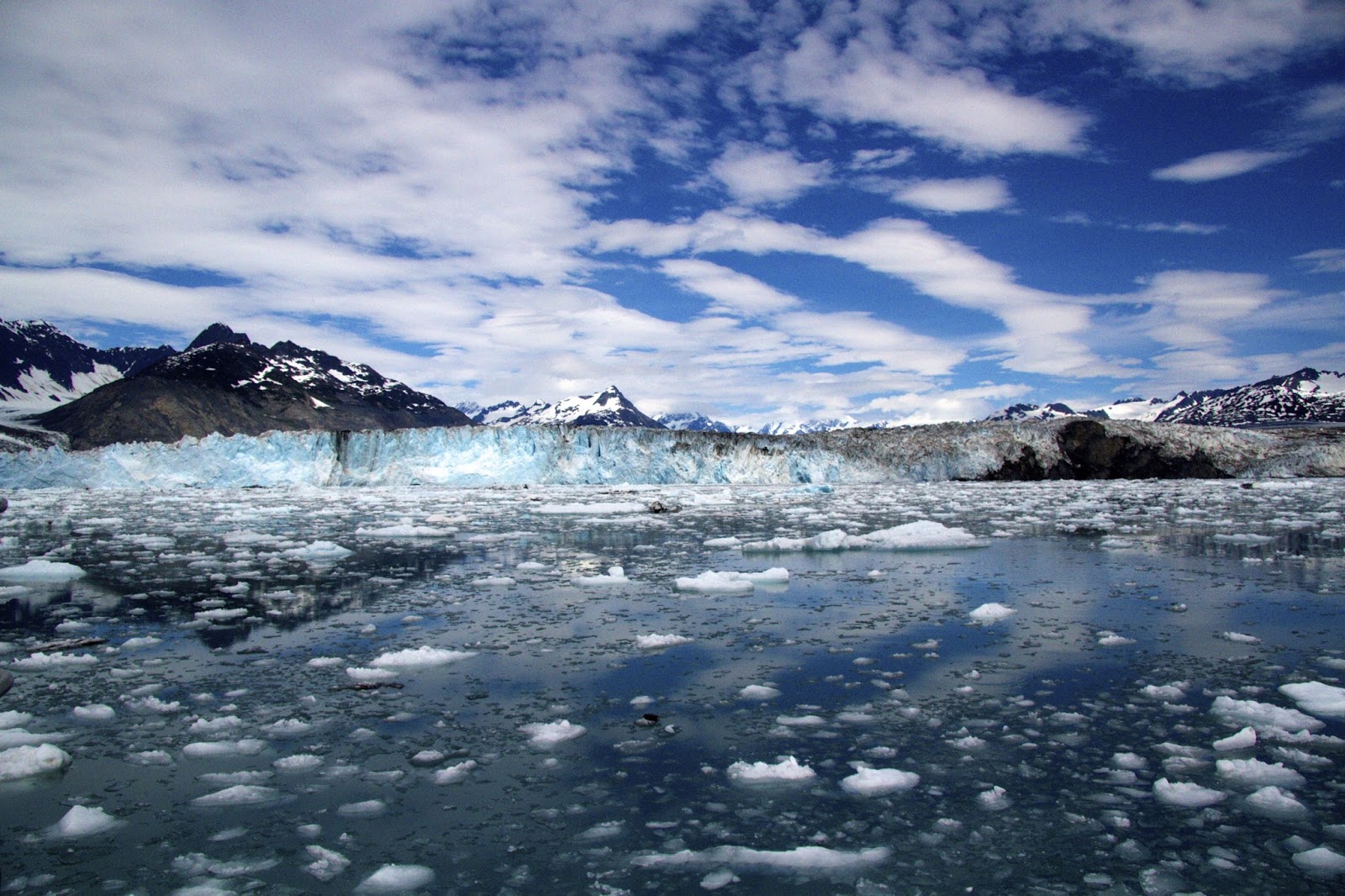
Columbia Glacier
As we approach the Columbia Glacier the captain circles a mother otter holding her baby, the mother dives down and vanishes from sight.  Then we continue on and pick our way through the ice.  It’s the only time the captain is quiet.  The glacier calves a bit and we head back to Valdez.  The boat has a small snack bar.  Chris gets a nasty hot dog and I have a watery bowl of tasteless clam chowder.  YUK!  On the return trip the captain takes the opportunity to share his misogynistic opinions on: government regulations, unions, the environment and foreign ownership of American based businesses with his captive audience.  There are speakers everywhere on the boat and we cannot escape his ramblings.  It’s like watching a Nat Geo show with a Rush Limbaugh commentary. We now have headaches and we just want him to STFU! Once we dock, we can’t get off the boat fast enough. Despite the glowing recommendations, this was certainly not the tour for us.

Otter
We book a second tour.  This time, it’s with the Stan Stephens Tours on the Valdez Spirit to the Meares Glacier.  This boat is a 82 ft. catamaran we are at about 60% capacity, but there are enough indoor seats with huge windows for a full house and it is much more comfortable than the previous tour boat.  Again the weather is perfect. Our Captain Amanda Bauer begins the tour with much of the same dialogue on the history of the area (without snarky editorial comments.) She is articulate and very knowledgeable about her topics.  She explains how the Alaska pipeline and the oil tanks were designed for a thirty-year lifespan. It’s now been thirty-eight years.  With maintenance and improvements they may be used for about fifty years.  We pass the rafts of otters, the purse seiners and Bligh Reef the site of the Exon Valdez oil spill where she tells us about the event, how unprepared anyone was for a disaster of this magnitude, how there is still cleanup going on in Kodiak and the Aleutian Islands, and some species of sea life have not recovered. Now there are improvements, processes and special equipment in place to help prevent this type of disaster and mitigate the destruction if a spill were to occur.  Passing the entrance to the Columbia Glacier, Amanda explains that the Columbia is a retreating glacier and the Meares is one of the few advancing glaciers.  At this point we feast on a lovely lunch of chicken with Alfredo sauce on a bed of rice with steamed vegetables, rolls and butter and Oreo cookies for desert.  

Happy Humpback
Meares Glacier
Calving
Heading toward the Meares, we spot a mother otter with her baby, the boat veers to the side away from the otters because baby otters do not know how to dive and if the mother dives too fast to get away from the boat, the baby can drown. At the base of the Meares, we sit in silence and watch spectacular calving as two huge chunks of ice, fall from the face of the glacier into the sea.  On the return trip we cruise by the epicenter of the 1964, 9.2 magnitude earthquake.  Amanda spots some Dalls Porpoises but they seem more intent on heading away and don’t stick around to play.  And then someone spies a whale spout.  Our captain heads the boat in the direction and soon a 40 ft. humpback breaches off the bow.  We slowly circle the area and are treated to a real show.  This whale is breaching then swimming on his back with his large pectoral fins waiving in the air and then diving and breaching.  This goes on and on over and over, waiving pectorals, rolling, diving and breaching.  Everyone watches in silence and awe.  We finally have to leave and Amanda states that this is the first time she has ever had to leave a frolicking humpback before it’s done.  We cruise around past the Stellar Sea Lion Colony and observe them from a distance. Amanda explains that although the colony in the Prince William Sound is stable, they are endangered because all of their other colonies are in decline.  Then we head off to watch the puffins doing their puffin thing. Before returning to port, we have a lovely bowl of clam chowder that’s tasty and full of goodies. It’s a beautiful relaxing ride back into port and we wish the day could go on forever.

Across the bay is the Solomon Falls Gulch Fish Hatchery.  They incubate and release the Pink (Humpback) Salmon that are currently being caught in the sound.  We visit the hatchery twice but the salmon are not running yet and there are no tours offered here.  However, there are some salmon nearby as indicated by the seals, that surface occasionally with a fat salmon in their mouths. 

Old Valdez
We also drive out to the Old Valdez Site.  The city was rendered uninhabitable by the 1964 earthquake and accompanying tsunami. It was relocated two and a half years later to the present site.  All that’s left of Old Valdez are decaying pier pilings. The salvageable buildings were moved to current Valdez and the rest were burned. Now the earth is slowly reclaiming the city site. 

The Valdez Museum Society has two locations. The Museum Annex near the ferry terminal is dedicated to Old Valdez, with artifacts, a scale model of the entire town and short film about the area, the destruction and the relocation.  A few blocks away, the Valdez Museum is a wonderful place to learn the history of both Old and New Valdez.  They have some wonderful exhibits including the beautifully restored original fire wagon.  We watch a short film about the history of the city from the native fishing villages to the boom and bust cycles: as the gateway to Yukon gold, the destruction and relocation after the 1964 earthquake, the building of the Alaska Pipeline and the current economy of oil, fishing and tourism.
Dead Bear Walking

On our last morning the Bear has returned.  He has systematically turned every trashcan over and gone through the contents.  A park employee arrives and chases the bear off, but the bear lets him get pretty close before running away. I can’t help but wonder why the park uses plastic trashcans and not bear-proof receptacles? They know that bears come into the area for the salmon, why make it easy for them to stay for the garbage?  This bear is back, he has no fear of people, and he will become dangerous if allowed to continue this behavior.  He’s a dead bear walking.

We head to the terminal to catch the ferry to Wittier. On the ferry we meet a couple from Valdez, they tell us that on their way to the ferry they saw trash cans by the post office turned over by the bear. I show them the photo I took earlier.  We talk about bears and they mention that last year, thirteen problem bears were shot in Valdez.  Thinking back I don’t recall seeing bear-proof trashcans around Valdez.  OK, so obviously bullets are cheaper than bear-proof trashcans… but WTF?

k

Monday, July 1, 2013

AND NOW FOR THE "OTHER" ALASKA...


The last ferry ride of this leg of our journey takes us to Haines, AK.  It’s beautiful cruising along the inside passage, we see humpback whales spouting off the bow of the Columbia, a perfect day for a cruise. 

crab feed
Haines Harbor
For three days our home in Haines is the Ocean Side RVPark.  We are right on the water with a wonderful view of the small boat harbor and within walking distance to downtown Haines.  They even have a Dungeness crab feed and potluck one evening.  Chris actually went down to the docks with one of the owners and another guest and helped clean 38 crabs for the feed. Now he can add cleaning crab in Haines Alaska to his ever-growing list-o-talents LOL.

After setting up we stroll over to the Lighthouse Restaurant.  We arrive just in time as they are expecting a busload of French tourists any minute.  We get our order of Halibut Fish and Chips and a Captain’s Platter of: shrimp, halibut, wings and fried mozzarella before the crowd arrives.  Although they are slammed, the service is friendly and the food perfectly prepared and delicious.  Portions are large and we again have leftovers for some tasty fish tacos the next day. 
Lighthouse on Urbanspoon

That night there is a huge storm.  Thunder shaking and lightning flashing it’s pretty exciting, but we don’t know how exciting until the next day, when everyone in town is enthusiastically talking about the weather.  Seems lightening in Haines is rare, so rare that the locals have never seen lightening like this.  One man told us that his 18-year old daughter had never seen lightening at all, until last night. Had we know, we might have gone out and shot some photos, but standing outside near a line of metal RVs in a thunder storm just didn’t seem like a good idea.


Ft. Seward
Hammer Museum
Haines has a few attractions worth visiting.  Historic Fort Seward  has been converted to private residences and art galleries, but much of it is still intact and we can imagine a busy fort defending the Alaska Coast.  At Alaska Indian Arts, Inc. we stroll through the working artist galleries, chat with some of the artists and purchase a small print by Greg Horner  to mount on the wall above our media center. The Sheldon Museum and CulturalCenter has a wonderful collection representing the culture of the Chilkat Valley.  They combine historic relics from the Tlingit culture, with nineteenth and twentieth century displays. Well worth a stop.  We assume that’s it for history and culture, but Haines has one more museum offering:  The Hammer Museum!  From the outside it looks like one of those quirky roadside attractions with a giant hammer standing in the yard of a small wood frame house, but inside there are examples of just about every hammer you can imagine and some we never imagined. This is the world’s first museum dedicated to the history of humanity’s first tool.  With a couple of thousand different hammers on display (and thousands more in storage) this museum is quirky for sure, but it is also fascinating.  The hammers are well documented and there are two young docents willing to share lots of information about the tools.

We drive out to Chikoot Lake and hike a bit about the lake.  Mosquitos are rampant but the ThermaCELLs work perfectly! There is a salmon weir across the river and we watch the poor ranger wading in the water trying to count the few early arriving salmon in the area.

Haines Highway in Fog


After three days we head out on the Haines Highway.  We have read and heard that this is one of the most scenic highways in Alaska.  Unfortunately the road is shrouded in fog and we’ll just have to take their word on this.  Not a lot of wild life either, just a couple of picas and a trumpeter swans.


Crossing the Canadian border is a breeze for us. We hand over all

Welcome to Canada, eh...
documentation (vehicle registrations, drivers license, insurance cards and passport cards.) We answer a few questions about where we were going and if we have guns, ammo, tobacco, alcohol, beer, pets and if anyone is in the trailer, no questions about food and we are sent on our way with a smile. 

We arrive at the Kluane RV Kampground in Haines Junction for a one-night stop.  Parking is on dirt; they have full hookups, OK Wi-Fi, but no trash receptacles so we have to pack out our trash (weird.) 

The list of attractions in Haines Junction is very short.  There’s the village monument at the junction of the Haines and Alaska Highways is a 24-foot high sculpture with area wildlife depicted in close to life-size detail on a mountain.  It’s nick named “The Muffin” and belongs in the category of quirky roadside attractions that are just quirky. You can’t miss this one but there is another attraction that should be on the NOT TO MISS LIST!  The Da Ku “Our House” Culture Center features Champagne and Aishihik First Nations cultural exhibits and the Kluane National Park Reserve Visitor Center.  This is one of the finest visitor centers we have ever visited it’s World Class!  Tons of hi-tech interactive interpretive displays keep us busy and stimulated until the center closes.  The park is an empire of mountains and ice. Here in a vast international preserve, are most of the tallest peaks in North America and the largest ice fields outside the polar caps. Over half the land mass is permanently draped in snow and ice – the remainder fosters forests and tundra and stable populations of eagles, grizzlies and other species often at risk elsewhere. We’d like to stay and explore but Alaska is our goal this summer, so we will make it a point to return and visit this park in the future.

Along the ALCAN
World's largest Gold Pan
So we rise early the next morning armed with our 2013 edition of the Milepost and head out on the Alaska Highway towards Tok. The skies are hazy and we later learn that there are 115 active fires burning in Alaska and even the main road between Anchorage and Fairbanks was closed for one day due to heavy smoke.  The scenery should be breathtaking but much of the forests are brown and dry; decimated by the spruce beetle and clouded by heavy smoke. We make a brief stop at the Tachal Dahl Visitor Center,  and learn a bit about the Dahl sheep in the area. No Sheep here this time of year as they are all grazing on the other side of the mountain.  In the roadside attraction category we pass by the world’s largest gold pan in Burwash Landing.

Black Bear
Mama & Baby Moose
The road is everything we have ever heard about the ALCAN: rough frost heave sections marked by orange flags where we slow down, muddy sections, and some smooth sections where the road is recently repaired, you just never know what’s up ahead. It’s overcast and hazy with intermittent showers so we decide to push all the way to the border.   We keep our eyes peeled for Yukon wildlife.  A pair of trumpeter swans fly parallel to the highway at the same speed we’re going (40+mph) and land in a pond and we finally see a scruffy black bear just before the border.  A the U.S. border we drive through a big orange scanner (like the ones at the airport except it’s for vehicles) show the agent our passport cards answer a few questions about guns, pets and if anyone else is in the trailer and are welcomed back to the U.S. We then drive the 90 miles onto Tok and along the way we finally see our first moose. WOO HOO!

(BTW Tok is pronounced “Toke” the “e” is missing)

Everyone driving into Alaska has to pass through Tok.  For such an important crossroads we note that in peak season, the multiple RV parks are pretty empty and vacancy signs abound on the hotels.  There are multiple gas stations, one well-stocked grocery store and a few small businesses catering to locals and tourists.  They have a fancy visitor center that is a clearing-house for brochures about anything you can do in the state.  Talking with some of the locals they describe the town as a boom and bust town they also note that this year they are seeing more large RV’s so they hope that the next boom is on the way.  Like the rest of Alaska they are having a heat wave and for us the smoky air is a déjà vu from last summer.

In Tok we stay two nights at the Tok RV Village.  The spaces are all full service pull-through and they give us one free hour of Wi-Fi per day.  Since everything is within walking distance we leave Dave and Dimples hitched.

The Alaska Burger
Fast Eddies is the only restaurant in town and they don’t let that go to their heads.  Service is fast and friendly and the food is excellent.  They offer a great salad bar with lots to choose from and their other dishes are generous.  The seafood platter is fresh, crisp and delicious and the Alaskan Burger is just about one of the tastiest burgers ever.  It’s also so huge that one order can be shared.  We actually eat there twice it’s so good!
Fast Eddy's Restaurant on Urbanspoon


Alaskan Husky
All Clean!
 Tok is known for two things: dog mushing and car washing.  We catch a mushing demonstration by Howling Raven Kennels.  These canine athletes are amazing and we have a new appreciation for the sport.  Dave and Dimples also get a bath.  So now that everyone is all shiny and clean it’s time to head south where clear skies and no smoke are reported towards Valdez…


k